Artificial intelligence could produce one of the largest economic transformations in modern history if its current pace of development continues, according to Anthropic co-founder Jack Clark.
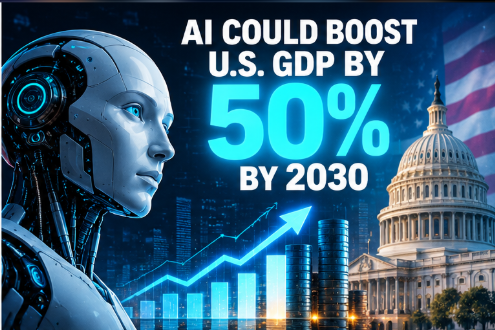
Speaking at the IMF and World Bank annual meetings in Bangkok, Clark said one of Anthropic’s internal models estimated that U.S. economic output could potentially rise to around $44 trillion by 2030 under certain conditions.
That would represent an increase of almost 50% compared with current U.S. GDP levels above $30 trillion. Reuters
Clark acknowledged that the forecast sounds extraordinary.
However, he argued that AI is beginning to accelerate scientific research in ways that could lead to completely new industries, technologies and products.
AI Could Change More Than Office Work
Much of the public debate around artificial intelligence currently focuses on chatbots, coding assistants and automation.
Clark argued that the more important long-term impact could come from science.
Advanced AI systems could potentially help researchers solve complex problems in:
- medicine,
- biology,
- mathematics,
- engineering,
- materials science,
- and drug discovery.
Instead of one scientist working alone, future researchers could potentially work with hundreds or thousands of specialized AI assistants.
That could dramatically shorten the time needed to test ideas, analyze data and discover new technologies. Reuters
But Faster AI Also Means Faster Risks
Anthropic’s message was not purely optimistic.
Clark warned policymakers that the period during which governments can create effective safeguards may be surprisingly short.
He said there is increasing evidence that technological progress could begin moving faster than governments and institutions are capable of adapting.
AI systems are already being tested on increasingly complex scientific and cybersecurity tasks.
That creates enormous opportunities but also potentially serious risks.
For example, the same technology that helps scientists understand biological systems could theoretically be misused to assist in the creation of dangerous pathogens.
Clark argued that biological research should therefore face some of the strongest human oversight and transparency requirements. Reuters
Jobs Will Not All Be Affected the Same Way
Another important issue is employment.
AI is already reducing demand for some positions in areas with high levels of automation exposure, particularly customer service and call-center work.
At the same time, Clark argued that AI could increase productivity and employment in scientific and technical fields.
The biggest unknown is how many entirely new industries could emerge.
History shows that major technologies often eliminate some categories of work while creating others that previously did not exist.
AI could follow the same pattern — but potentially at much greater speed.
Why This Story Matters
Anthropic is one of the world’s leading AI developers, meaning statements from its leadership carry significant weight in discussions about how quickly artificial intelligence is progressing.
The company is also reportedly preparing for an IPO that could value it at as much as $2 trillion, adding another economic dimension to the debate. Reuters
The central message is therefore unusual.
Anthropic is effectively saying that AI could create extraordinary economic growth while simultaneously warning that governments may only have a few years to build systems capable of keeping the technology under control.
That tension is likely to define the next phase of the global AI race.

Leave a comment
Your email address will not be published. Required fields are marked *