
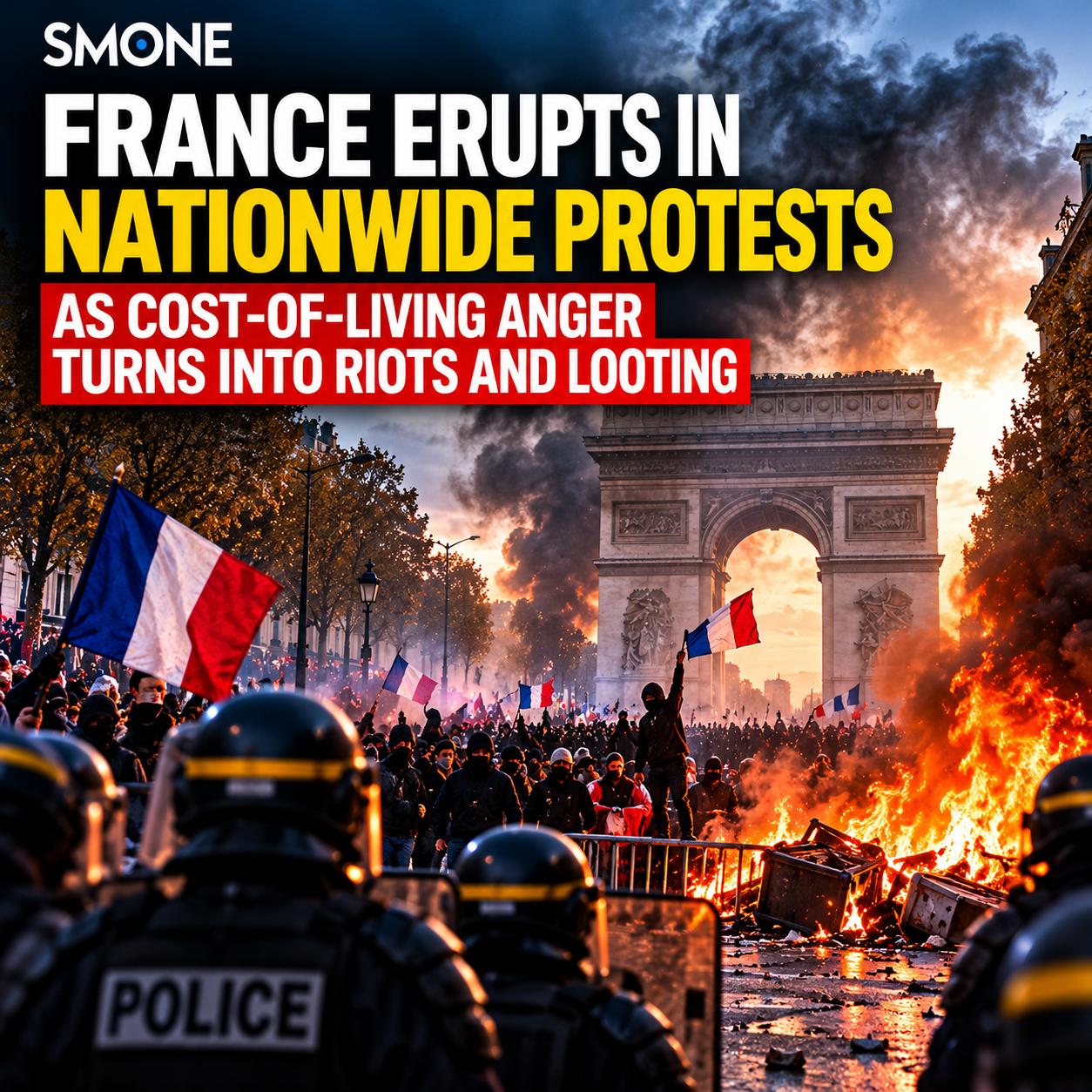
France is facing one of its most serious waves of public unrest in years after nationwide demonstrations over the cost of living and public services escalated into riots, looting and violent confrontations with police.
The demonstrations on October 17 drew hundreds of thousands of people across the country, with major rallies taking place in Paris, Marseille, Lyon, Bordeaux and several other cities.
France’s Interior Ministry estimated that approximately 550,000 people participated nationwide, while union estimates were higher. Around 110,000 demonstrators gathered in Paris alone. Financial Times
The movement originally grew from student protests over education conditions but quickly expanded as workers, activists and citizens frustrated by rising living costs joined the demonstrations.
Fuel prices, grocery bills, housing expenses and concerns about government spending have helped turn the protests into a much broader expression of dissatisfaction.
Peaceful Marches Turn Violent
Many demonstrations began peacefully.
However, violence broke out after masked groups clashed with police and began damaging property in several cities.
Central Paris experienced some of the most serious disruption.
Shops were broken into and looted, while fires were reported near protest routes.
Similar incidents were reported in Marseille, Lyon, Lille, Bordeaux and Strasbourg.
In Limoges, the city hall was badly damaged by fire during the unrest. Financial Times
French authorities said approximately 1,200 people were arrested nationwide, while around 150 police officers were injured.
The scale of the disorder prompted the government to deploy a large security presence across major cities. Financial Times
What Started the Protests?
The current movement did not begin as a single protest over one issue.
Student groups had already been demonstrating over conditions in schools and universities.
Among their concerns were education funding, the Parcoursup university admissions system, teacher resources and the cost of studying.
Those demonstrations gradually attracted support from university students, teachers, workers and some activists associated with previous Yellow Vest protests.
By mid-October, the movement had evolved into a wider protest against economic inequality and the increasing cost of everyday life. Le Monde.fr
This expansion explains why demonstrations have attracted people from very different backgrounds.
For some participants, education remains the central issue.
For others, the protests have become a way to express frustration about wages, inflation, fuel prices, housing and the quality of public services.
Government Condemns Violence
French Prime Minister Sébastien Lecornu condemned the destruction and attempted to distinguish between peaceful demonstrators and people involved in riots or looting.
President Emmanuel Macron also said those responsible for violence would face consequences.
The unrest is politically sensitive because France is moving closer to another presidential election period.
Political parties have already begun blaming one another for the escalation.
Far-right leader Marine Le Pen has accused figures on the left of encouraging disorder, while left-wing politicians have criticized the government’s economic policies and police response. Financial Times
Comparisons With the Yellow Vest Movement
The scenes have inevitably generated comparisons with the Yellow Vest movement, which began in 2018.
That movement initially focused on fuel taxes but eventually became a broader revolt against economic inequality and living costs.
The current protests have different origins, particularly because student organizations played an important early role.
However, several underlying frustrations are similar.
When people feel that wages are not keeping pace with housing, food, transportation and energy costs, a protest over one issue can quickly become a wider political movement.
Unrest Spreads Beyond France
The impact is already being felt outside France.
Several hundred demonstrators clashed with police in Brussels on October 17 during protests partly inspired by events in neighboring France.
Belgian students were protesting rising education costs and concerns about access to higher education.
Police used tear gas and water cannons after some demonstrators overturned a vehicle. Reuters
The Brussels demonstrations show how economic and educational frustration can spread across borders when young people in neighboring countries face similar pressures.
What Happens Next?
The biggest question is whether the French protest movement can maintain its momentum.
School holidays could temporarily reduce student participation, but broader dissatisfaction over living costs may continue.
The government must now manage two challenges at the same time: responding to legitimate economic concerns while preventing further violence and destruction.
If demonstrations continue to attract workers, students and Yellow Vest activists simultaneously, France could face a prolonged period of political instability.
For businesses and travelers, developments in major cities will also be important.
Transport disruption, road closures and demonstrations could affect travel plans if further large protests are announced.

Leave a comment
Your email address will not be published. Required fields are marked *