
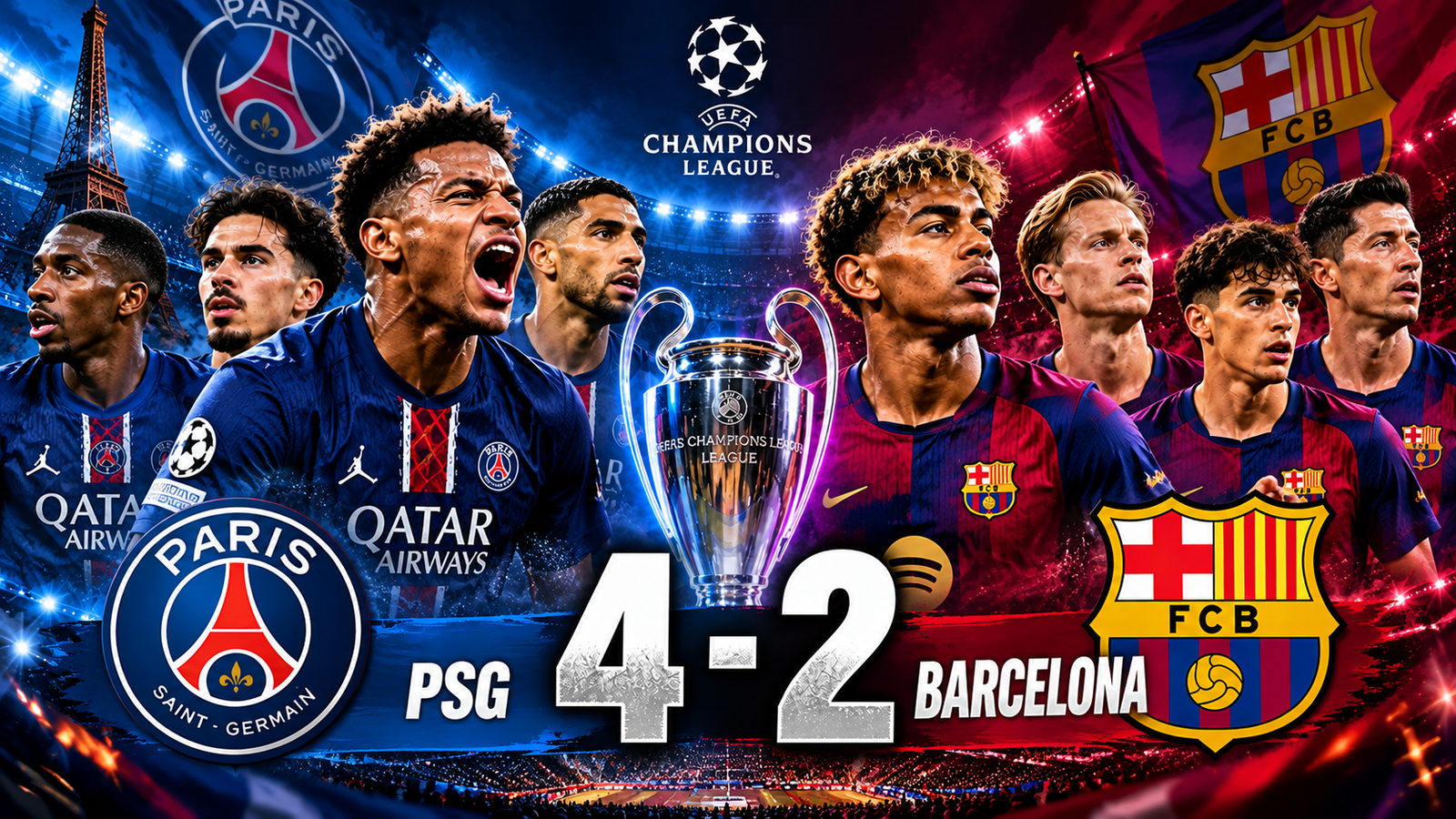
Paris Saint-Germain defeated Barcelona 4-2 at the Parc des Princes on October 20, 2026, handing Hansi Flick’s team their first defeat of the season and maintaining PSG’s perfect start to the UEFA Champions League league phase.
The match delivered almost everything expected from a meeting between two of Europe’s most attacking teams: six goals, 40 attempts, outstanding goalkeeper saves, individual brilliance, defensive errors and several major missed chances.
Désiré Doué opened the scoring for PSG in the 38th minute before Barcelona youngster Xavi Espart equalised shortly after half-time. Lucas Hernández restored PSG’s advantage in the 72nd minute, but Lamine Yamal produced another moment of individual quality to make it 2-2 seven minutes later.
Barcelona’s comeback lasted barely two minutes. Vitinha fired PSG back in front in the 81st minute before Fabián Ruiz completed the 4-2 victory five minutes later. Sky Sports
| Minute | Scorer | Team | Score |
| 38' | Désiré Doué | PSG | 1-0 |
| 55' | Xavi Espart | Barcelona | 1-1 |
| 72' | Lucas Hernández | PSG | 2-1 |
| 79' | Lamine Yamal | Barcelona | 2-2 |
| 81' | Vitinha | PSG | 3-2 |
| 86' | Fabián Ruiz | PSG | 4-2 |
The final score tells only part of the story. Barcelona actually had more possession, but PSG created the clearer chances and repeatedly attacked the spaces behind the Catalan defence. Maxifoot
PSG Dominated the Dangerous Areas Despite Barcelona Having More Possession
Barcelona finished the match with 53% possession compared with PSG’s 47%, and completed 537 passes at an 88% success rate. PSG completed 481 passes at 85%.
But the attacking statistics heavily favoured the French champions.
PSG produced 22 shots, including 15 on target, compared with Barcelona’s 18 attempts and only five on target. Expected goals also favoured Paris by 3.73 xG to 2.19 xG. Maxifoot
That difference explains the match better than possession does.
Barcelona moved the ball well for long stretches and occasionally played through PSG’s pressure, but Paris consistently created more dangerous situations once the ball reached the final third.
PSG were especially dominant before half-time. Opta reported that 10 of their first 12 attempts were on target, the most shots on target Barcelona had faced in the first half of a Champions League match since at least 2003-04. Opta Analyst
Joan García was therefore one of Barcelona’s busiest and best players despite conceding four goals.
Désiré Doué Was PSG’s Main Threat
Désiré Doué produced one of the strongest performances of the evening.
The 21-year-old caused Barcelona problems with his acceleration, movement and willingness to attack defenders directly. He scored the opening goal and continued creating danger after the break.
The goal also came from one of Barcelona’s most costly mistakes.
Lamine Yamal attempted an ambitious chipped pass while Barcelona were trying to move the ball out of defence. João Neves intercepted it, PSG immediately attacked the exposed Barcelona back line, and Doué cut inside before finishing low past Joan García. The Guardian
Several post-match ratings named Doué as PSG’s standout performer, with Athlon giving him 9/10 and Man of the Match. Athlon Sports
His Champions League numbers are becoming increasingly impressive as well. Opta noted that Doué has now been directly involved in 16 goals across his last 16 Champions League appearances, with nine goals and seven assists. Opta Analyst
Joan García Kept Barcelona Alive
It might seem strange to praise a goalkeeper after a 4-2 defeat, but without Joan García the score could have been considerably worse.
PSG repeatedly broke through Barcelona’s defensive structure during the first half.
García denied Ousmane Dembélé and Doué in quick succession early in the game, later stopped Ferran Torres from close range and also reacted quickly to keep out Fabián Ruiz.
He finished with 10 saves. Sky Sports
Some Barcelona-focused ratings even considered him the team’s best performer despite the four goals conceded.
The statistic is also a warning for Hansi Flick: when a goalkeeper makes 10 saves and his team still loses by two goals, the defensive structure in front of him has clearly allowed too many dangerous situations.
Xavi Espart Delivers on the Biggest Stage
One of Barcelona’s biggest positives was Xavi Espart.
The 19-year-old showed remarkable confidence in one of the most difficult away fixtures in European football and scored his first Champions League goal.
Barcelona’s equaliser in the 55th minute came from one of their best collective moves of the match. Fermín López found Espart advancing into space on the left, and the youngster drove his finish beyond Safonov to make it 1-1. Opta Analyst
Barcelona started four teenagers — Lamine Yamal, Marc Bernal, Xavi Espart and Pau Cubarsí — in the same Champions League match for the first time in the club’s history, according to Opta. Opta Analyst
Espart therefore left Paris with one of the most memorable moments of his young career even though Barcelona ultimately lost.
Barcelona’s Set-Piece Defending Cost Them
After Barcelona equalised, PSG began applying heavy pressure again.
Ferran Torres hit the post from close range, and the resulting corner led to PSG’s second goal.
Barcelona failed to properly account for Lucas Hernández inside the penalty area. The PSG defender found enough space to attack the delivery and powered a header beyond a helpless Joan García in the 72nd minute. The Guardian
This was one of the clearest defensive mistakes of the evening.
Against elite opponents, allowing a powerful aerial player that much room from a corner is extremely costly.
Barcelona’s problems were not simply about individual defenders being beaten. There were moments when the entire defensive structure became stretched, leaving PSG players with unusually large amounts of space.
Lamine Yamal Produces Magic — but Also Makes a Costly Error
Lamine Yamal had a complicated night.
His mistake helped PSG score the opening goal, but he later produced one of Barcelona’s finest moments of the match.
In the 79th minute, Yamal recovered possession after an error involving Warren Zaïre-Emery, drove into the penalty area from the right and finished brilliantly from a tight angle to make it 2-2. Opta Analyst
The finish demonstrated exactly why Yamal remains such a dangerous player even when he is not dominating a match.
At only 19, the goal was his 13th in the Champions League, tying Kylian Mbappé for the most Champions League goals ever scored by a teenager. Opta Analyst
However, his performance also illustrated the fine margins of elite football.
His risky ball in Barcelona’s defensive third contributed directly to Doué’s opening goal. Later, his equaliser appeared to have rescued Barcelona — only for PSG to score again two minutes later.
So Yamal was simultaneously involved in one of Barcelona’s biggest errors and one of their best attacking moments.
Vitinha Punishes Barcelona Almost Immediately
Barcelona had barely finished celebrating Yamal’s equaliser when Vitinha changed the match again.
Achraf Hakimi attacked from the right and delivered a dangerous ball into the area.
Gerard Martín failed to clear decisively, leaving the ball available near the edge of the penalty area.
Vitinha controlled it with his chest and struck a powerful first-time effort beyond García to put PSG ahead 3-2 in the 81st minute. Opta Analyst
This may have been the decisive moment psychologically.
Barcelona had fought back twice, but conceding almost immediately after making it 2-2 destroyed much of the momentum they had created.
Vitinha was excellent throughout the game, combining PSG’s possession play with aggressive forward movement.
Alongside Doué and João Neves, he helped Paris win important midfield battles whenever Barcelona became stretched.
Fabián Ruiz Finishes Barcelona Off
By the closing minutes, Barcelona were chasing another equaliser and committing more players forward.
PSG exploited the additional space.
Hakimi was again involved from the right. His cross took a deflection and arrived at the unmarked Fabián Ruiz, who converted from close range in the 86th minute to make it 4-2. Opta Analyst
The defensive problem was obvious: Barcelona had lost their shape.
Fabián had too much space inside the penalty area for such an important late phase of the match.
That fourth goal removed any realistic possibility of another comeback.
Barcelona’s Biggest Problem Was Defensive Fragility
Barcelona did several things well.
They had more possession, produced 18 shots, scored twice away against the reigning European champions and created enough chances to remain competitive until the final minutes.
But PSG exposed the same risk that comes with Hansi Flick’s aggressive approach.
Barcelona want to press high, keep their defensive line advanced and commit players forward. When the press works, opponents struggle to escape.
When it does not work, enormous spaces can appear behind the midfield and defence.
PSG had the speed, technical quality and intelligence to exploit those spaces repeatedly.
The Guardian described Barcelona’s back line as particularly fragile and noted how PSG consistently found ways to attack the spaces on Barcelona’s right side. The Guardian
The numbers support that conclusion: conceding 15 shots on target and 3.73 expected goals is simply too much against an elite Champions League opponent. Maxifoot
Who Controlled the Match?
The answer depends on what is meant by “control.”
Barcelona controlled slightly more of the ball with 53% possession.
PSG, however, controlled the more important attacking moments.
Paris had more shots, three times as many efforts on target and a significantly higher expected-goals total.
They also entered half-time ahead after producing the stronger first 45 minutes.
Barcelona responded well after the break and equalised twice, meaning the match was competitive until the final 10 minutes.
But once the game became stretched late on, PSG looked physically stronger and considerably more dangerous.
That is why the 4-2 result was not simply the product of clinical finishing. PSG created enough opportunities to justify winning the game. Opta Analyst
Biggest Missed Chances
The score could easily have been even higher.
Khvicha Kvaratskhelia struck the post in the opening minutes after Pedri was caught in possession. Dembélé fired the rebound wide, although the offside flag was eventually raised.
Anthony Gordon also received a promising opportunity early on but could not make the most of it.
PSG then forced García into several excellent saves before Doué finally opened the scoring. Sky Sports
Barcelona also wasted important opportunities.
Fermín López had a major chance to equalise shortly before half-time but Safonov blocked his attempted chip in a one-on-one situation.
At the other end, Ferran Torres struck the post shortly before Hernández scored PSG’s second goal. Opta Analyst
With 11 big chances between the teams, the six-goal final score could easily have become seven or eight. Opta Analyst
Injuries Add Another Story to the Match
The spectacular football came with a significant injury cost.
Ousmane Dembélé was forced off inside the opening 20 minutes after appearing to suffer a hamstring problem.
Khvicha Kvaratskhelia also left the game after taking a knock.
Barcelona had problems of their own, with Dani Olmo withdrawn during the first half. Sky Sports
The timing is particularly uncomfortable for Barcelona because Flick’s team are preparing for El Clásico against Real Madrid.
Any additional injury problems could influence the way Barcelona approach that match.
Barcelona’s Perfect Start Is Over
Before arriving in Paris, Barcelona had won all 11 matches in all competitions this season, scoring 50 goals.
PSG became the first team to stop that perfect run. Opta Analyst
For Paris, the result makes it three Champions League wins from three.
For Barcelona, the defeat should not create panic, but it gives Flick a very clear warning.
The attacking quality is unquestionably there.
Yamal remains capable of producing goals from almost nothing, young players such as Espart continue to develop, and Barcelona can create chances against virtually any opponent.
But their defensive structure needs improvement when facing teams capable of playing quickly through pressure.
PSG did exactly that — and punished almost every major defensive weakness Barcelona showed.
Final Verdict: PSG Deserved the Win
Barcelona had enough good periods to make the match competitive, but PSG were ultimately the better and more dangerous side.
Désiré Doué was arguably the standout player, while Vitinha was decisive when the game reached its most important phase. João Neves gave PSG aggression and control in midfield, and Hakimi repeatedly contributed to attacks down the right.
For Barcelona, Joan García was outstanding despite conceding four goals. Xavi Espart delivered an excellent performance for a teenager at this level, and Lamine Yamal again showed why he can change matches individually.
But football at this level is often decided by mistakes.
Yamal’s risky pass contributed to the first goal. Barcelona left Hernández too free for the second. Gerard Martín’s incomplete clearance preceded Vitinha’s third, and Fabián Ruiz was left unmarked for the fourth.
PSG punished those errors ruthlessly.
Final score: Paris Saint-Germain 4-2 FC Barcelona.
And on a night featuring 40 shots, six goals and two Barcelona comebacks, the reigning European champions once again demonstrated why they remain one of the teams to beat in the Champions League.

Leave a comment
Your email address will not be published. Required fields are marked *